
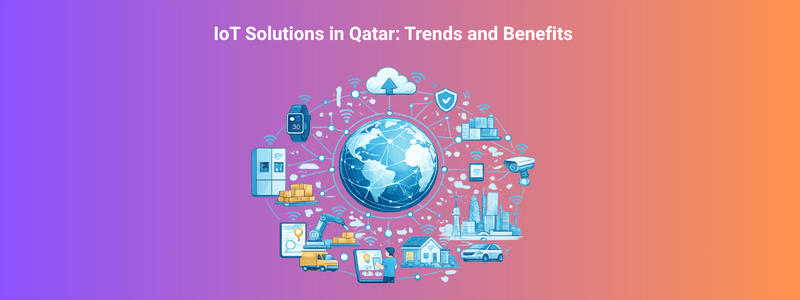
The Internet of Things (IoT) has evolved from entering into trial deployment to significant enterprise adoption in Qatar; it is expected to be one of the most effective technologies that includes how enterprises play across industries by 2026. From smart infrastructure to connected logistics, industrial monitoring to healthcare automation stages, IoT is allowing organizations to collect real-time data, gain better visibility over resources or machines, automate operations, and make timely business decisions.
For Qatar, IoT expansion is closely tied to the country’s broader digital transformation agenda. Thanks to national investments in smart infrastructure, digital public services, high-speed connectivity, and data platforms, nations are rapidly creating attractive conditions for connected systems. Because enterprises now want more than just traditional IT systems, operating intelligence derived directly from devices, sensors, machines, and connected environments is becoming a driver of enterprise demand.
Putting it simply, published estimates indicate that Qatar’s IoT market is currently in a healthy growth cycle, and with total market value likely to grow substantially over the next 10 years as connected infrastructure becomes more ubiquitous across the public and private sectors. The market was over USD 2.3 billion by 2025 according to industry estimates, and is poised for continued growth through 2034 as investment in digital programs continues. (IMARC Group)
This compound growth represents a significant shift in the mindset of enterprises. Companies are now moving past the question of whether connected systems make sense to pinpointing where IoT can generate quantifiable operational value.
Digital Foundations In Qatar Are Fast-Tracking IoT Adoption
One of the primary contributors to Qatar’s rapid growth in IoT is its strong digital infrastructure. Enterprise IoT relies heavily on stable connectivity, low-latency communication, cloud environments that scale effortlessly, and secure data handling. Qatar invested in much of the foundational work to make advanced IoT deployment so practical there when compared to many other emerging digital markets.
Enterprise Arena further strengthens its readiness for connected solutions due to a nationwide 5G footprint, fiber expansion, and cloud ecosystem building. Why it matters is that IoT systems often feature thousands of parallel data exchanges between devices, platforms, and apps.
According to recent market reports, there’s a direct correlation between the adoption of IoT and the demand for cloud services, driving software-defined data center growth in Qatar as enterprises allocate more and more spend on scalable digital infrastructure. (GlobeNewswire)
The strength of this infrastructure means that businesses can deploy connected systems with increased reliability and lower performance boundaries.
The Future of IOT in 2026 – Connected Operations, not Isolated Devices
One of these trends is that enterprises will shift from deploying isolated devices to connected operational ecosystems in the future IoT 2026.
Previous IoT projects typically focused on single devices such as smart meters, tracking units or individual sensors. The next phase is different. Businesses increasingly want Internet of Things (IoT) systems that plug directly into analytics platforms, enterprise applications, AI models and decision workflows.
This creates much more value because data no longer gets stuck inside single devices.
Instead, enterprises can apply connected systems to enable:
- Live monitoring
- Predictive maintenance
- Operational alerts
- Automated reporting
- Cross-system decision support
The pattern is even more pronounced in industrial segments, logistics landscapes, utilities, and smart workplaces.
In Qatar, organizations are now increasingly aligning IoT deployments to broader digital transformation objectives – not treating it as directional technology experiments.
Enterprise IoT Opportunities Driven By Smart City Expansion
Qatar’s smart city development is still one of the biggest drivers for IoT adoption. One area of such demand is urban projects (smart districts, connected buildings, digital utilities, and intelligent transport systems) that drive large-scale demand for sensors, data platforms and connected service layers.
This digitalization of urban areas has a cascading effect on private enterprises as many commercial industries follow suit after observing successful implementations in public infrastructure.
Qatar is expanding opportunities for Internet-of-things integration across urban systems using technology for clean energy, pollution control and AI-enabled IoT remote monitoring solutions for efficient sustainability development has attracted foreign investment in pursuit of smart city objectives, according to the latest analysis. (Qatar Day)
For enterprises, this creates new customer expectations in IoT adoption that are shaped by their experiences in increasingly connected smart urban environments.
These include retail spaces, office towers, industrial campuses and hospitality environments all expected to perform more intelligently.
Industrial Internet of Things Will Boon To Boom In 2026
The enterprise IoT segment that Qatar should focus on most over the coming years would be the Industrial IoT.
Industries including oil and gas, manufacturing, utilities and industrial logistics are especially suited for IoT since they operate high-value equipment that produces quantifiable operational data.
Connected industrial systems allow organizations to shift from reactively managing their operations to predictive control.
Whereas failure is imminent, the connected machines can give you early warning signals through the vibrations they create or changes in pressure, temperature, etc.
Industrial IoT Benefits Include
- Predictive maintenance
- Downtime reduction
- Equipment visibility
- Energy optimization
- Process efficiency
These improvements directly impact the cost that creates a significant financial burden due to industrial downtime.
The technology can also make workplaces safer by alerting staff to abnormal behavior before an incident occurs.
Logistics and Supply Chain IoT Will Become More Intelligent
In Qatar, the logistics industry is getting more leverage from IoT as connected tracking information allows for better movement visibility among warehouses, fleets and delivery systems.
IoT no longer simply monitors location. A new generation of connected logistics systems keep watch on temperature, route performance, vehicle condition, fuel efficiency and delivery timing.
This creates stronger operational control.
For supply chain-connected businesses, connected logistics enhances:
- Asset visibility
- Delivery accuracy
- Fleet efficiency
- Cold-chain reliability
- Route intelligence
The more data driven they become, the less optional IoT becomes.
As device activation and scaling across fleets and distributed assets becomes easier, eSIM standards growth globally as well as low-power devices connectivity are also expected to further strengthen enterprise logistics IoT in 2026. (TechRadar)
The Integration of AI and IoT into Intelligent Enterprise Systems
- IoT is data-generating and AI is data-transforming into prediction, prioritization, and intelligent action.
- And this combination makes up what many enterprises refer to as operational intelligence today.
- For instance, IoT sensors could indicate that the temperature of equipment has changed, but AI will assess whether it means a maintenance risk.
- In commercial settings, for example, IoT sensors can track occupancy while AI calibrates cooling, lighting and energy systems autonomously.
- This alignment means that IoT is increasingly more valuable connected to analytics platforms than in silo.
Healthcare IoT Will Go Beyond Just Monitoring
In 2026, healthcare organizations in Qatar are also likely to further intensify its adoption of IoT.
Connected healthcare is slowly transitioning from basic wearable monitoring to broader operational scenarios.
Hospitals increasingly use IoT for:
- Asset tracking
- Patient environment monitoring
- Equipment performance alerts
- Cold storage validation
Smart room controls
This provides improved operational control and quality of service to patients.”
By automating and connecting systems, we will help to minimise manual checks of medical infrastructure whilst improving visibility across the board.
Energy Efficiency Is Becoming a Major IoT Business Driver
One of the most powerful enterprise justifications for IoT implementation is energy optimization.
Connected systems are being used in an increasing number of buildings, industrial sites, warehouses and commercial environments to minimize waste and increase efficiency.
Lighting, cooling, occupancy and system performance are each continuously monitored by sensors.
This helps enterprises to reduce unnecessary energy consumption on an auto-pilot mode.
In Qatar, (where climate conditions create high demand cooling load), smart energy control offers strong value at cost.
Common Energy-Focused IoT Use Cases
- Smart HVAC control
- Occupancy-based lighting
- Utility monitoring
- Equipment energy analysis
This will also accelerate in commercial real estate and industrial operations.
Security Is a Primary Focus in 2026 IoT Deployments
Security is one of the biggest enterprise concerns as IoT continues to grow.
Connected devices create a potential digital entry point if left unprotected.
That means strong device identity, access controls and encrypted communication, along with monitoring should be built into your IoT strategy.
The issue is that most organizations will deploy devices before defining security governance.
Security from the start is best practice.
Enterprises are adopting the following approaches to secure IoT environments:
- Device authentication
- Network segmentation
- Encrypted communication
- Access policy control
- Continuous monitoring
This withholding makes it dangerous to scale connected systems.
The Role of Private 5G in Bolstering Enterprise IoT in Qatar
Private connectivity is becoming increasingly relevant as some enterprise IoT environments need more stringent control than public networks can offer.
Private 5G enables companies to enable low-latency communication environments dedicated only to them within industrial plants, logistics hubs or smart campuses.
This enhances reliability for high-volume IoT applications.
Private 5G and real-time connected operations are becoming a global enabler for enterprise networks, which marks an important phase in the transformation towards intelligent infrastructure. (IT Pro)
In Qatar, this is currently particularly relevant for industrial and infrastructure-heavy sectors.
The True Long-Term Benefit of IoT? Data Value
IoT is not just about automation; their true enterprise value has something more. It is data.
Connected systems provide an ongoing stream of operational insight that legacy reporting fails to capture.
This allows enterprises to understand:
- Usage patterns
- Failure trends
- Performance gaps
- Environmental conditions
- Operational timing
Strategic decisions become better with the cumulative data.
Businesses that embrace the Internet of Things (IoT) early on often end up with a long-term advantage as they build operational intelligence faster than competitors.
How Does Lack Of Integration Planning Result In IOT Projects Disaster?
Most of the IoT projects fail when a business only focuses on hardware.
Sensors do not generate business value on their own; they must be attached to business systems.
Integrating IoT Deployment with other Solutions. A robust deployment of IoT needs the integration of:
ERP systems
- Analytics tools
- Alerts
- Dashboards
- Workflow automation
- Without integration, data remains underused.
This is why successful enterprises start with business outcomes first, not device selection first.
How Carmatec Qatar Supports IoT Solutions
In Qatar, for businesses to truly benefit from the Internet of Things ( IoT), successful deployment goes beyond simply installing connected devices. This needs to have secure architecture, scalable integration, a cloud-ready nature, and data intelligence.
Enterprises need to build their IoT ecosystems, creating large, scalable digital systems comprising devices, applications, analytics, and workflows, and Carmatec Qatar enables them to do so.
Its IoT services include:
- IoT application development
- Sensor integration platforms
- Cloud-connected device ecosystems
- Enterprise dashboard development
- Predictive analytics integration
This enables companies to grow from pilot deployments into enterprise-quality connected operations.
Conclusion
Enterprises’ investments in IoT solutions (especially smart monitors, including sensors and terminals) to drive visibility, efficiency, and digital competitiveness in Qatar will be increasingly defined by 2026. Industrial operations, logistics, healthcare, facilities, and smart service environments increasingly rely on connected systems – these technologies convert physical activity into actionable intelligence.
For companies in Qatar, IoT is no longer just about devices; it’s about creating smart operational systems to enable continuous digital advancement.
 English
  العربية
