
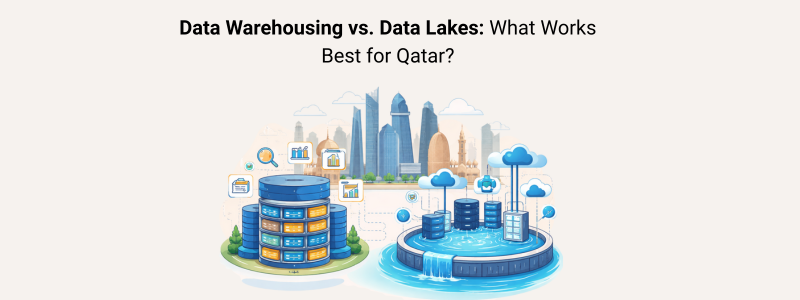
With data becoming critical in driving growth strategies, organizations are looking at ways to manage the storage, management, and analysis of all that data. The demand and stakes for utilizing data successfully are greater today than ever before in fast-rising economies with rapid growth, such as Qatar. There are no shortcuts to it, that’s why enterprises – across the board – continue to invest heavily in analytics, artificial intelligence (AI), and digital projects which need good quality data.
The two most common strategies for managing data are those of the data warehouse and the data lake. Although both are data storage solutions, they vary in terms of architecture, functionality, and applicability. Deciding whether to go with a data warehouse or a data lake is not just a technical decision but also a strategic one that can affect how Qatari businesses analyze their data, refine their operations, and, more importantly, forecast the future.
This massive guide investigates the distinctions between data warehousing and data lakes, as well as their respective benefits and challenges – along with which of them is more suitable for businesses situated in Qatar’s one-of-a-kind economy and legal ecosystem.
What is the Role of Data Architecture in Qatar?
Qatar plans to transform itself into a knowledge-based economy and is currently witnessing a rapid digital transformation with nationwide initiatives, smart city visions, and infrastructure projects in place. Companies like energy, finance, healthcare, construction & retail & transport, etc, are generating a large amount of structured as well as unstructured data.
With companies investing heavily in next-gen technologies such as AI, IoT, and predictive models, there is a growing need for a scalable data architecture. Data warehousing vs. data lakes Data warehousing and data lakes offer two best-of-breed complementary approaches to support the variety of business needs for large volumes and complex varieties of data, as well as the demand for fast insights.
Understanding Data Warehousing
A data warehouse is a system consolidated for recording and managing data that has been cleaned, transformed, and aggregated in an appropriate form for use. They are optimized for querying and reporting, hence used for business intelligence (BI) and performance monitoring.
In a data warehousing system, it is a common practice to extract data from several operational systems, to transform them into a homogeneous format, and to build the warehouse by loading this transformed data. Consistent with this programmatic approach, structured data provides accuracy and reliability for decision-making and regulatory determination.
Core Characteristics of Data Warehouses
A data warehouse is a collection of data structured to support specific types of queries. This schema-on-write process creates high-quality data, so your data is performant in queries and accurate for reporting.
Since data warehouses deal with historical and aggregated information, they are suitable for producing dashboards, financial reports, and key performance indicators. Qatar businesses that demand quality over quantity: compliance, standardized reporting–yes, many are now (shock!) using data warehousing.
Understanding Data Lakes
A data lake is a single, centralized repository that allows you to store all your structured and unstructured data at any scale. Data lakes, unlike data warehouses, use a schema-on-read method of organization-the structure is applied upon accessing for analysis.
Data lakes are built for large-scale, diverse data; data that is continuously growing and is in multiple formats, such as structured, sensor data, and unstructured text. They support flexibility and expandability so you can hold large quantities of data with no predefined form.
Core Characteristics of Data Lakes
Data lakes focus on flexibility and scale, not structure. Such systems can collect data from various sources, such as sensors, social media, logsets, and multimedia.
Data scientists and analysts can use this flexibility to test data, create predictive models, and find insights that aren’t obvious in a standard reporting environment. Data lakes have a lot of promise for organizations in Qatar that are looking for innovation-led projects.
Data Warehousing vs Data Lakes – What’s the difference?
The distinguishing factor between data warehousing and data lakes is how the data stored in each one is handled. Data lakes store raw data and structure it later; a data warehouse requires the data to be structured before it’s stored.
This difference has an impact on performance, usability, and governance. Data lakes are designed for flexible and exploratory analytics, whereas data warehouses provide fast and dependable insights for well-defined queries. Knowing the differences is key to selecting which There are specific differ- way to take in Qatar’s varied business landscape.
Performance and Query Efficiency
Data warehouses are designed for high-performance querying and reporting. They are ordered and efficient, so you can use them in operational dashboards or executive reports.
Data lakes, though highly scalable, may need extra processing layers to work at the same speed. But analytics engines and cloud infrastructure advances have brought query efficiency in data lakes to a fairly acceptable level in this day and age.
Data Governance and Compliance
For businesses in Qatar, including those in regulated sectors such as finance and banking, healthcare, energy, and others that rely on data to make decisions or engage with their customers, data governance matters a great deal. Due to their structured nature and controlled data ingestion mechanisms, data warehouses have excellent governance facilities.
To avoid problems like data sprawl, quality inconsistencies, data lakes need stronger governance regimes. If well-managed and with security controls in place, a data lake can also satisfy compliance demands, but requires more attention and effort.
Cost Considerations
The cost is an important factor in data architecture choices. Data warehouses are more costly, both up front (transformation of the data, optimizing for storage, licenses) and operationalizing it into governance programs like wheels(coordination among six sigma, lean, etc.) workflows in order to maintain/operate that structure as well.
Cloud-hosted data lakes provide cheap storage and scalability in particular. Qatar-based companies that are looking to handle high volumes of stored data without the initial outlay component may see a cost advantage in this model.
Applications of Data Warehousing in Qatar
Data warehousing is well-suited to structured data and regular reports. This includes banking, government organisations, and around-the-clock operation environments, which need to be monitored daily for compliance purposes.
Data warehouses allow for precise financial reporting and operational analysis as well as historical trend analysis. Their reliability and efficiency make them a good baseline for business intelligence projects.
Examples of Use of Data Lakes in Qatar
If you are an organization that is driving innovation, doing advanced data analytics, and creating data-driven experiments, then a data lake is perfect for you. In sectors, including natural resources (energy), transportation, and smart infrastructure in Qatar, high volumes of heterogeneous data are being produced that can also be orchestrated well in a data lake.
The data lake is a playground for التعلُّم الآلي, predictive analytics, and real-time data processing that allows organizations to get insight that can fuel innovation and competitive advantage.
Hybrid Paths and The Modern Data Architecture
More and more companies in Qatar are going hybrid on data with a combination of data warehousing and the design of a ‘data lake. This method combines the advantages of both systems and avoids the shortcomings.
Hybrid model: Raw data is kept in a data lake, and curated, structured files are processed and sent to the data warehouse for reporting/querying. This framework can then cater to both operational excellence and deep analytics.
Scalability and Future Readiness
High scalability is crucial for companies that consider long-term development. Data lakes can be scaled almost endlessly, ideal for businesses that expect explosive data growth.
Data warehousing can be deployed to scale as well, especially in cloud environments, but it takes planning so that costs and performance are effectively controlled. When deciding on a scalable data architecture, Qatari companies need to consider both the estimates of their future growth and analytics requirements.
Security and Risk Management
Organizations working with sensitive data prioritize security. Access controls, encryption and monitoring tools can protect data warehouses just as they safeguard data lakes.
But then, as data lakes are open, they need more security to prevent unauthorized access and ensure the integrity of the data. Building robust security models is therefore imperative to secure data safeguard in a regulated environment.
Selecting the Best Strategy for Qatar-Founded Firms
Which approach is right for the organization? The selection between data warehousing and DDS will be based on a variety of parameters such as business objectives, nature of data, compliance requirements, analytical maturity, etc. If you are a structured reporting and compliance-driven institution, you might benefit from datamarting.
For those whose focus is on innovation, sophisticated analytics, or storing large amounts of data, a data lake may be more conducive to the way they work. The mixed approach is often the most reasonable compromise and geared for the future.
Implementation Considerations and Best Practices
For the successful mounting of the data warehouse or data lake, you would need to have a clear objective, buy-in from stakeholders, and stringent governance for data. Organizations need to take a look at where they are with their data today, determine the use cases, and invest in the proper tools and know-how.
Education and change management are key as well to drive adoption and usage around data platforms. Following best practices can help organizations in Qatar realize more value from their data investments.
Strategic Implication of Data Architecture Decisions
Decisions on data architecture have consequences for long-term business agility, innovation, and competitive stance. Selecting the right one allows companies to adapt to market shifts with agility, transform operations, and fuel growth.
There is no such thing as data warehousing vs. data lakes in the digital economy of today’s Qatar, but there are fully integrated and fluid components of an end-to-end contemporary enterprise information management strategy. The trick is to get technology choices to help in reaching those strategic aims.
الخاتمة
Data warehousing and data lakes both present various benefits to businesses aiming to unlock the value of data. Where data warehouses shine in structured reporting and governance, data lakes can offer flexibility and scalability to support sophisticated analytics and innovation.
Depending on the industry, type of business, and regulations you have to meet, there may be a certain ideal kind of company. Most of the businesses are using the combined power of both flavour and hybrid source architecture. With the expertise and a solid strategy, companies like كارماتك قطر assist organizations in planning and deploying data solutions that can inspire insight, drive efficiency, as well sustainable growth in an increasingly data-powered world.
الأسئلة المتداولة
1. What’s the main difference between a data warehouse and a data lake?
A data warehouse stores cleaned, structured data that’s ready for business reporting and analytics, using a predefined schema before data is stored. In contrast, a data lake holds raw data in its native format-structured, semi-structured, or unstructured-and applies structure only when the data is used. This makes warehouses great for fast, reliable BI queries, while lakes offer greater flexibility for diverse analytics and data science work.
2. When should businesses in Qatar choose a data warehouse?
Organizations in Qatar that need reliable executive reporting, consistent business intelligence dashboards, regulatory compliance, and fast SQL queries will benefit most from a data warehouse. Because the data is already transformed and validated at ingestion, teams get high data quality and consistent results for strategic decisions. This model works well for sectors like finance, government, and retail analytics where structured data predominates.
3. What makes data lakes a strong option for advanced analytics in Qatar?
Data lakes shine when businesses are dealing with large volumes of diverse data types, such as log files, social media, IoT streams, or machine learning datasets-common in smart city and digital transformation initiatives. Their schema-on-read approach allows data scientists in Qatar to explore raw datasets without rigid structure upfront. This flexibility supports innovation, AI/ML use cases, and predictive analytics.
4. Are there cost or complexity considerations for Qatar organizations choosing between these options?
Yes-data lakes tend to be cheaper to scale for storing huge volumes of raw data because they use cost-efficient object storage, but they require more governance and skilled engineers to manage quality and security. Data warehouses often involve higher initial design and processing costs, but they deliver predictable performance and easier analytics for business users. Choosing one depends on budget, team skills, and analytical goals.
5. Should Qatar companies consider using both data lakes and data warehouses together?
Many organizations now adopt a hybrid approach-using a data lake to collect and store diverse raw data and a data warehouse to power structured analytics and reporting. This lets teams leverage real-time streams and flexible analytics from the lake, while the warehouse provides trusted and fast insights for business intelligence. Such integration supports both data science innovation and operational reporting needs.
 English
  العربية
