
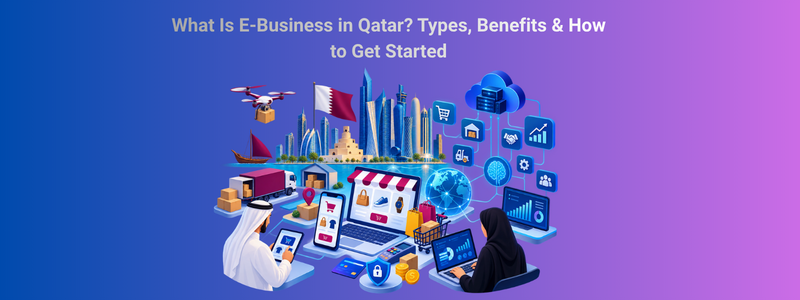
Qatar’s rapidly evolving digital economy is creating new opportunities for businesses to sell products, deliver services, engage customers and manage operations online. From online retail and digital banking to cloud-based business management and mobile services, organisations across Qatar are increasingly moving beyond traditional business models.
This broader shift is known as e-business.
While e-commerce primarily focuses on buying and selling products or services online, e-business covers a much wider digital ecosystem. It includes online sales, customer relationship management, digital payments, supply chain management, marketing automation, internal operations, data analytics, mobile applications and technology-driven customer experiences.
For businesses operating in Qatar, adopting an e-business model can improve operational efficiency, expand market reach and create more convenient experiences for customers.
In this guide, we explore what e-business in Qatar means, its major types, benefits, examples, essential technologies, challenges and the steps businesses can take to build a successful digital operation.
What Is E-Business?
E-business refers to the use of digital technologies, internet-based platforms and connected systems to operate, manage and grow a business.
It encompasses much more than an online shop.
An e-business can use technology for:
- Selling products and services
- Receiving digital payments
- Managing customer relationships
- Automating business processes
- Managing inventory and orders
- Coordinating suppliers
- Running digital marketing campaigns
- Providing online customer support
- Managing employees and internal workflows
- Analysing business data
- Delivering services through mobile applications
- Integrating CRM, ERP and accounting platforms
For example, a retail company in Doha may have an e-commerce website where customers place orders. Behind that website, the company may use an ERP system for inventory, a CRM platform for customer data, a payment gateway for transactions, analytics tools for business intelligence and automated notifications for order updates.
Together, these technologies form an e-business ecosystem.
E-Business vs E-Commerce: What Is the Difference?
The terms e-business and e-commerce are often used interchangeably, but they do not mean exactly the same thing.
التجارة الإلكترونية
E-commerce focuses primarily on online commercial transactions.
Examples include:
- Buying clothes through an online store
- Ordering groceries through an app
- Booking a hotel room online
- Purchasing software subscriptions
- Paying for services through a website
E-Business
E-business is broader and includes e-commerce as one component.
For example, an online retailer may use:
- E-commerce for online sales
- CRM for customer management
- ERP for business operations
- AI for personalised recommendations
- Cloud technology for infrastructure
- Analytics for decision-making
- Automation for order processing
- Digital marketing for customer acquisition
Therefore:
E-commerce is a part of e-business, whereas e-business encompasses the wider digital operation of an organisation.
Why Is E-Business Important in Qatar?
Qatar has been investing heavily in digital infrastructure, digital government, technology adoption and the development of its digital economy. This creates an increasingly supportive environment for organisations looking to adopt technology-driven business models.
The country’s strategic focus on digital transformation is also encouraging businesses to rethink how they interact with customers and manage operations.
For companies in sectors such as retail, banking, healthcare, logistics, hospitality, education and professional services, e-business can become an important part of long-term growth.
Key factors driving e-business adoption in Qatar include:
- Increasing smartphone usage
- Growing consumer expectations for digital services
- Greater adoption of online payments
- Demand for convenient customer experiences
- Growth of mobile applications
- Expansion of cloud computing
- Increasing use of artificial intelligence
- Digital transformation across industries
- Growth of online marketplaces
- Need for more efficient business operations
Businesses that combine these technologies strategically can create digital experiences that are faster, more convenient and easier to scale.
Types of E-Business Models in Qatar
E-business can take several forms depending on who is involved in the transaction or relationship.
1. Business-to-Consumer (B2C)
B2C is one of the most familiar e-business models.
Here, a business sells products or services directly to individual customers through digital channels.
Examples
- Online fashion stores
- Grocery delivery platforms
- Food ordering apps
- Online electronics stores
- Travel booking platforms
- Digital subscription services
A Qatar-based retailer, for example, could operate a website and mobile application allowing customers to browse products, make payments and track deliveries.
2. Business-to-Business (B2B)
B2B e-business involves transactions or digital relationships between companies.
A B2B platform might allow businesses to:
- Request quotations
- Place bulk orders
- Manage accounts
- Track purchases
- Access product catalogues
- Communicate with suppliers
- Automate procurement
For example, a wholesale distributor in Qatar could create an online B2B portal where restaurants and retailers place recurring orders.
B2B digital platforms can significantly reduce manual processes and improve communication between organisations.
3. Consumer-to-Consumer (C2C)
C2C platforms allow consumers to interact and transact with other consumers.
Examples include:
- Classified websites
- Resale marketplaces
- Community marketplaces
- Used-product platforms
The platform typically provides the infrastructure for listing products, communication, payments or other transaction-related services.
4. Consumer-to-Business (C2B)
In a C2B model, individuals offer products, services or value to businesses.
Examples include:
- Freelance professionals
- Content creators
- Photographers
- Consultants
- Influencers
- Independent designers
Digital platforms can make it easier for businesses in Qatar to discover and work with specialised professionals.
5. Business-to-Government (B2G)
B2G e-business involves digital interactions between businesses and government organisations.
Examples include:
- Digital procurement
- Online tenders
- Government supplier portals
- Electronic documentation
- Online applications
- Digital invoicing
As government services become increasingly digital, businesses also need technology capable of participating in these ecosystems.
6. Government-to-Citizen (G2C)
G2C describes digital services delivered by government organisations to citizens and residents.
Examples include:
- Online government applications
- Digital document services
- Online payments
- Public-service portals
- Digital identity services
Although G2C is not a conventional commercial model, it demonstrates how digital platforms can transform interactions between organisations and users.
Key Components of an E-Business
A successful e-business is rarely built around a single website. Instead, it relies on multiple interconnected technologies.
1. Business Website or Web Application
The website is often the primary digital touchpoint between a business and its customers.
A modern platform should be:
- Mobile-friendly
- Fast
- Secure
- Easy to navigate
- Search-engine friendly
- Accessible
- Scalable
Depending on the business model, the platform could include product catalogues, customer dashboards, booking systems, portals, subscriptions or personalised content.
2. Mobile Applications
Mobile apps can provide a more convenient experience for customers who frequently interact with a business.
A Qatar-based e-business could use an app for:
- Shopping
- Food ordering
- الأعمال المصرفية
- Appointment booking
- Loyalty programmes
- Delivery tracking
- Customer support
- Notifications
Mobile applications can also support location-based services, personalised recommendations and real-time communication.
3. Digital Payment Systems
Payments are a fundamental part of most e-business models.
Businesses should provide secure and convenient payment options appropriate to their customers and operating model.
Payment integration can support:
- Card payments
- Digital wallets
- Online banking
- Mobile payments
- Recurring billing
- Payment links
A properly integrated payment infrastructure can reduce friction during checkout and improve the overall customer experience.
4. Customer Relationship Management
A CRM system helps businesses manage customer information and interactions.
It can help teams track:
- Leads
- Customer enquiries
- Purchases
- Communication history
- Preferences
- Support requests
- Marketing interactions
Integrating CRM with an e-business platform can create a more complete view of the customer journey.
5. Enterprise Resource Planning
ERP systems connect important business functions through a central platform.
Depending on the organisation, ERP can support:
- Finance
- Procurement
- Inventory
- Human resources
- Sales
- Supply chain
- Operations
Integrating an e-business platform with ERP can reduce duplicate data entry and improve operational visibility.
6. Inventory and Order Management
For retailers and marketplaces, inventory and order management are particularly important.
An integrated system can help businesses monitor:
- Stock levels
- Product availability
- Orders
- Returns
- Warehousing
- Delivery status
Real-time information can also reduce the risk of selling unavailable products.
7. Data Analytics
Data gives businesses visibility into what customers are doing.
Analytics can reveal:
- Most popular products
- Customer acquisition sources
- Conversion rates
- Abandoned carts
- Repeat purchases
- Customer behaviour
- Sales trends
These insights allow organisations to make decisions based on actual business data rather than assumptions.
Benefits of E-Business in Qatar
1. Reach Customers Beyond Physical Locations
A traditional business may be limited by its physical location and opening hours.
An e-business can potentially reach customers across Qatar and, depending on its business model, international markets as well.
This creates opportunities for companies to expand without opening physical locations in every market.
2. 24/7 Availability
Digital platforms can remain accessible around the clock.
Customers can:
- Browse products
- Request information
- Place orders
- Make payments
- Book services
- Submit enquiries
outside traditional business hours.
This is particularly valuable for businesses serving customers with different schedules.
3. Better Customer Experience
Customers increasingly expect convenience.
They want to find information quickly, complete transactions easily and receive updates throughout the customer journey.
E-business enables companies to offer features such as:
- Personalised recommendations
- Online self-service
- Order tracking
- Instant notifications
- Multiple payment options
- Digital support
- Customer accounts
4. Reduced Operational Workload
Automation can eliminate repetitive manual tasks.
For example, instead of employees manually processing every order, an integrated platform can automatically:
- Receive the order
- Confirm payment
- Update inventory
- Notify the customer
- Send information to fulfilment
- Update the CRM
- Generate reports
This can save time while reducing avoidable errors.
5. Improved Decision-Making
Digital systems generate valuable operational data.
Management teams can analyse this information to understand:
- What customers want
- Where sales are coming from
- Which products perform best
- Where customers abandon purchases
- Which marketing channels deliver results
This makes strategic planning more data-driven.
6. Easier Business Scalability
A well-designed digital platform can support business growth more efficiently than a collection of disconnected manual processes.
Businesses can add:
- New products
- New locations
- New customer groups
- New payment methods
- New sales channels
- New integrations
without rebuilding their entire business infrastructure.
7. Personalised Marketing
E-business platforms can use customer behaviour and purchase history to create more relevant experiences.
Businesses can personalise:
- Product recommendations
- Email campaigns
- Promotions
- Offers
- Notifications
- Website content
Personalisation can help improve customer engagement and retention.
Examples of E-Business in Qatar
E-business can be applied across almost every major industry.
Retail and E-Commerce
Retailers can create integrated digital stores where customers browse products, purchase online and track deliveries.
Behind the scenes, the platform can connect with inventory, CRM, ERP, payment and logistics systems.
Banking and Financial Services
Banks and financial institutions use digital platforms for:
- Online banking
- Mobile banking
- Digital payments
- Customer onboarding
- Account management
- Notifications
- Personalised financial services
AI and analytics can further support fraud detection, customer service and risk management.
الرعاية الصحية
Healthcare organisations can use e-business technologies for:
- Online appointments
- Patient portals
- Digital records
- Telehealth
- Online payments
- Automated reminders
- Prescription management
The result can be a more connected patient experience.
Hospitality and Tourism
Hotels, travel companies and tourism businesses can use digital platforms for:
- Online bookings
- Mobile check-in
- Customer communication
- Digital payments
- Loyalty programmes
- Personalised offers
Qatar’s growing tourism and hospitality ecosystem makes digital customer experiences increasingly important.
Logistics and Supply Chain
Logistics companies can implement e-business solutions for:
- Shipment tracking
- Fleet management
- Digital documentation
- Customer portals
- Automated notifications
- Route optimisation
- Warehouse management
Integrating these systems can provide better visibility throughout the supply chain.
التعليم
Educational institutions can use digital platforms for:
- Online enrolment
- Course management
- Student portals
- Digital payments
- Online learning
- Communication
- Performance tracking
How to Start an E-Business in Qatar
Building an e-business requires more than launching a website. A structured approach can help businesses avoid expensive technology decisions later.
Step 1: Identify the Business Opportunity
Start by defining the problem you want your digital platform to solve.
Ask:
- Who are your customers?
- What do they need?
- What problem are you solving?
- Which parts of your business are currently inefficient?
- What do competitors offer?
- Which processes should be digitalised first?
A clear business objective should guide technology decisions.
Step 2: Select Your E-Business Model
Determine whether your business will operate primarily as:
- B2C
- B2B
- Marketplace
- Subscription-based
- Service-based
- Hybrid
The model will influence your platform architecture, payment system, customer journey and operational processes.
Step 3: Understand Qatar’s Business and Digital Requirements
Businesses should consider the regulatory, commercial and operational requirements relevant to their activities in Qatar.
Depending on the nature of the business, this may involve areas such as:
- Business registration
- E-commerce requirements
- Digital transactions
- Consumer protection
- Payment security
- Data protection
- Tax and accounting obligations
- Industry-specific regulations
Requirements can vary according to business activity and structure, so organisations should verify applicable requirements with the relevant Qatar authorities or qualified advisers.
Step 4: Plan the Digital Platform
Create a detailed specification before development begins.
Define:
- User journeys
- Core features
- Admin functionality
- Payment processes
- Integrations
- Security requirements
- Reporting requirements
- Scalability requirements
This helps prevent scope expansion and technical complications later.
Step 5: Choose the Right Technology
The technology stack should match your business requirements.
Depending on the project, an e-business platform could use:
- Custom web development
- Mobile app development
- شوبيفاي
- WooCommerce
- Magento/Adobe Commerce
- Enterprise portals
- Cloud platforms
- Headless commerce architecture
- Custom APIs
There is no universal platform that is best for every business.
A small online retailer may need a different solution from a large B2B marketplace with thousands of products and multiple integrations.
Step 6: Integrate Payments
Choose secure payment solutions suitable for your business model and customer base.
The payment experience should be:
- Simple
- Reliable
- Secure
- Mobile-friendly
- Easy to understand
Testing should cover successful payments, failed transactions, refunds, cancellations and other relevant scenarios.
Step 7: Connect Business Systems
Avoid building your digital platform as an isolated system.
Where necessary, integrate it with:
- إدارة علاقات العملاء
- ERP
- Accounting
- Inventory
- Warehouse management
- Shipping
- Marketing automation
- Customer support
- التحليلات
Integration creates a connected digital ecosystem.
Step 8: Build Security Into the Platform
Security should be considered from the beginning rather than added after launch.
Important areas include:
- Secure authentication
- Access controls
- Data encryption
- Secure payment processing
- API security
- Regular updates
- Backup strategies
- Monitoring
- Vulnerability testing
Businesses handling sensitive customer or financial information should take security particularly seriously.
Step 9: Test Before Launch
Testing should cover both technology and user experience.
Test:
- Website functionality
- Mobile responsiveness
- Checkout
- Payment processing
- APIs
- Integrations
- بحث
- Forms
- Notifications
- الأداء
- الأمن
- Browser compatibility
Real users should also be included in usability testing where possible.
Step 10: Measure and Improve
Launching your e-business platform is only the beginning.
After launch, monitor:
- Website traffic
- Conversion rates
- Customer acquisition
- Sales
- Repeat purchases
- Customer retention
- Support requests
- Page performance
- Abandoned carts
Use these insights to continuously improve the platform.
How AI Is Changing E-Business in Qatar
Artificial intelligence is becoming an important component of modern digital business.
Businesses can use AI to make digital experiences more intelligent and automated.
AI applications include:
AI-powered customer service:
Chatbots and virtual assistants can answer common questions and provide support.
Personalised recommendations:
AI can analyse customer behaviour to recommend relevant products or services.
Demand forecasting:
Machine learning can help businesses predict future demand and optimise inventory.
Fraud detection:
AI can identify unusual transaction patterns and potential risks.
Marketing automation:
AI can assist with customer segmentation, campaign optimisation and content personalisation.
Predictive analytics:
Businesses can use historical and real-time data to identify trends and anticipate outcomes.
Intelligent search:
AI-powered search can help customers find relevant products or information more quickly.
For Qatar-based organisations, combining e-business with AI can create opportunities for greater automation, personalisation and operational intelligence.
Common E-Business Challenges in Qatar
Despite its benefits, e-business implementation can involve several challenges.
Technology Complexity
Connecting multiple platforms can become complicated when systems have different APIs, data structures or technical requirements.
Cybersecurity Risks
Digital businesses face threats such as phishing, account compromise, malware, data breaches and payment-related fraud.
Customer Trust
Customers need confidence that their personal and payment information is handled responsibly.
Clear policies, secure technology and reliable customer support are essential.
Integration Problems
A website that does not communicate properly with inventory, CRM or ERP systems can create operational inefficiencies.
Scalability
A platform that works for 500 customers may not perform equally well with 500,000 users.
Scalability should therefore be considered during architecture planning.
User Experience
Even technically advanced platforms can fail if customers find them confusing.
Simple navigation, fast performance and an efficient checkout process remain essential.
Why Choose Carmatec for E-Business Development in Qatar?
Building an e-business platform requires a combination of business understanding, software engineering, integration expertise and digital strategy.
كارماتك قطر helps businesses transform ideas and traditional operations into scalable digital platforms.
Our capabilities can support different stages of an e-business journey, including:
- E-commerce development
- Custom software development
- Web application development
- Mobile app development
- B2B and B2C platforms
- التحوّل الرقمي
- Payment gateway integration
- CRM and ERP integration
- الحلول السحابية
- AI Development
- تحليلات البيانات
- API development
- الصيانة والدعم
Carmatec also has experience delivering digital commerce solutions for businesses in Qatar, including marketplace and mobile commerce projects.
One example involved developing mobile commerce applications for the Qatar retail market, integrating Android and iOS applications with an existing Magento platform and supporting capabilities such as product browsing, search, filtering, secure payments, loyalty programmes and promotions.
This type of integrated approach is particularly valuable for organisations that already have business systems but need a more connected digital experience.
E-Business Trends to Watch in Qatar
The future of e-business is likely to be shaped by several technologies and customer expectations.
AI-Driven Commerce
AI will increasingly influence recommendations, customer support, marketing and business intelligence.
Mobile-First Experiences
Customers are increasingly comfortable interacting with businesses through smartphones, making mobile optimisation essential.
Omnichannel Commerce
Businesses will connect websites, mobile apps, social platforms, physical stores and customer service into a unified experience.
Digital Payments
Faster and more convenient digital payment experiences will continue to influence online customer journeys.
Cloud-Based Operations
Cloud infrastructure enables businesses to access scalable computing resources without relying entirely on traditional on-premises infrastructure.
Hyper-Personalisation
Businesses will increasingly use data to create personalised offers and experiences for different customer segments.
Intelligent Automation
Routine processes such as order processing, customer communication, reporting and internal workflows can increasingly be automated.
Headless Commerce
Businesses with complex digital requirements may adopt headless architectures that separate the customer-facing experience from back-end commerce functionality.
E-Business Implementation Checklist
Before launching an e-business platform in Qatar, consider the following checklist:
Business Strategy
- Define your target customers
- Identify the business problem
- Select your e-business model
- Analyse competitors
- Define measurable objectives
التكنولوجيا
- Select the right platform
- Plan system architecture
- Define integrations
- Build responsive web experiences
- Consider mobile applications
- Plan scalability
Payments
- Select appropriate payment methods
- Integrate payment processing
- Test transaction workflows
- Implement appropriate security controls
Operations
- Connect inventory systems
- Integrate CRM
- Integrate ERP where required
- Define order management
- Plan delivery and fulfilment
الأمن
- Secure customer accounts
- Protect sensitive information
- Implement access controls
- Secure APIs
- Establish monitoring and backup procedures
النمو
- Set up analytics
- Create SEO strategy
- Plan digital marketing
- Implement conversion tracking
- Monitor customer behaviour
- Continuously improve the platform
Build a Future-Ready E-Business in Qatar
E-business is no longer simply about putting a company online. It is about creating a connected digital ecosystem in which customers, employees, business processes and technology work together.
For businesses in Qatar, this transformation can open new channels for growth while improving operational efficiency and customer engagement.
Whether you are planning an online marketplace, B2B portal, e-commerce website, mobile commerce application or a fully integrated digital business platform, the right technology strategy can make the difference between simply having a digital presence and building a scalable digital business.
كارماتك قطر can help you plan, develop and integrate the technology needed to turn your e-business idea into a practical, scalable solution.
Ready to take your business digital? Partner with Carmatec to build a smarter e-business solution in Qatar.
Frequently Asked Questions About E-Business in Qatar
What is e-business in Qatar?
E-business in Qatar refers to using websites, mobile applications, cloud platforms, digital payments, automation and connected business systems to operate and grow a business digitally.
Is e-commerce the same as e-business?
No. E-commerce primarily concerns online buying and selling, while e-business includes e-commerce as well as digital operations such as CRM, ERP, supply chain management, customer service, analytics and automation.
What are some examples of e-business?
Examples include online stores, digital banking platforms, food delivery applications, online marketplaces, B2B portals, booking platforms, healthcare portals and subscription services.
Is e-business suitable for small businesses in Qatar?
Yes. Small businesses can start with a focused digital platform and gradually introduce advanced features such as automation, CRM, analytics and mobile applications as the business grows.
How much does it cost to build an e-business platform in Qatar?
The cost depends on factors such as platform type, design, number of features, integrations, mobile applications, payment requirements, security, scalability and ongoing support. A simple digital platform will generally require a very different investment from an enterprise marketplace.
How long does it take to develop an e-business platform?
Development time depends on the complexity of the project. A basic platform can be delivered more quickly than a large-scale marketplace requiring ERP, CRM, payment, logistics and mobile integrations.
Can AI be integrated into an e-business platform?
Yes. AI can be integrated for customer service, recommendations, predictive analytics, fraud detection, intelligent search, marketing automation, demand forecasting and other use cases.
Why work with a local e-business development company?
A development partner familiar with the Qatar market can help businesses understand local customer expectations, digital payment requirements, industry considerations and integration needs while delivering the required technology.
 English
  العربية
