
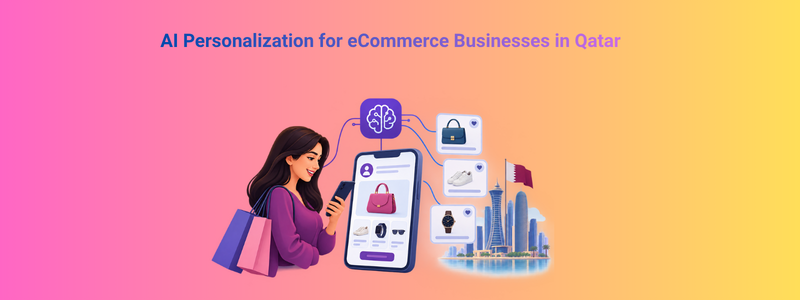
With more consumers accessing a higher number of online stores, better product ranges and faster digital services, the eCommerce sector in Qatar is becoming increasingly competitive. In this kind of environment, an attractive website or competitive pricing is not enough to keep customers. More and more online shoppers expect brands to understand their preferences, offer relevant recommendations, streamline the path to purchase and communicate with them at the right time. This is where **AI personalization for eCommerce businesses in Qatar** is becoming a critical strategy to drive client engagement, conversion rates and long term loyalty.
Artificial intelligence enables eCommerce companies to analyse large sets of data collected from customers and shopping activities and to use those insights in order to deliver personalised experiences. Instead of showing the same products, offers and content to every visitor, artificial intelligence can dynamically tailor the online shopping experience based on browsing behaviour, purchase history, preferences, location and real-time interactions. This level of personalisation is a huge competitive advantage for companies operating in the diverse and digitally connected market in Qatar.
What is AI Personalisation in E-Commerce?
AI Personalisation refers to the use of artificial intelligence and machine learning technology to deliver personalised shopping experiences for each individual customer. Simple personalisation might involve a rule to show a product a customer has previously viewed or to email them after they abandon something in their shopping cart. AI- driven personalisation goes way beyond that, by looking at patterns across multiple data points to predict what a customer is most likely to need or buy.
For example, an online fashion store in Qatar can use AI to learn what categories of clothing a customer likes, the price range they prefer, their favourite colours and brands, and how they browse. Then the platform is able to recommend products that fit those preferences. Similarly, an electronic shop can target customers interested in smartphones and show them relevant accessories, upgrade options, warranty plans or complementary products automatically.
AI personalisation can be applied at every step of the customer journey. It can affect the products shown on the homepage, search results, product recommendations, promotions, email campaigns, ads and even customer support interactions. We want to make every interaction more relevant and easy.”
How AI Personalisation is Driving Growth in Qatar’s eCommerce Market
Qatar’s consumer market is digitally connected with high levels of online services and mobile technology penetration. Businesses have grown used to frictionless digital experiences that customers have come to expect to be fast, simple and relevant. As competition for online customers increases, personalisation can differentiate a brand.
The diversity of Qatar’s consumer base makes personalisation especially valuable. Companies may have customers from different cultures, who speak different languages, and have different buying habits, budgets and product preferences. Not all marketing techniques work the same for everyone. AI is able to identify different customer segments and build experiences that are personalised for them.
For example, an ecommerce platform can identify customers who shop at particular times, customers who like to buy premium products, or customers who regularly purchase household essentials. The business can create hyper-relevant experiences for each segment, rather than blasting the same campaign out to all users.
Personalisation can also reduce the amount of effort a customer has to put in. When the shopper is given relevant suggestions rather than needing to sort through hundreds of items, they are able to find what they want quicker. A better buying experience leads to increased customer satisfaction and repeat purchase.
AI-Driven Product Recommendations
One of the most common uses of AI personalisation is to make smart product recommendations. Recommendation engines analyse customer behaviour to work out which products are likely to be relevant to a given shopper.
These systems may leverage historical purchase data, product views, searches, cart activity, product ratings, customer segments and interactions from similar users. This data enables AI to suggest products on the fly.
For example, if a customer buys a smartphone, the system may recommend compatible cases, chargers, screen protectors, wireless earbuds or other accessories. For example, a customer who frequently views formal wear in a clothing store might be recommended additional accessories, shoes or new formal wear options.
Personalised recommendations allow eCommerce companies in Qatar to boost their average order value and help receive recommendations for additional accessories, shoes,search Experiences. Search is one of the most important eCommerce features. Usually, when customers come to an online store, they are looking for a specific product or category. But old-fashioned keyword search doesn’t always get at the customer’s intent.
Using natural language processing, previous behaviour, product characteristics and contextual cues, artificial intelligence can improve search. AI-powered search is more than matching keywords, it understands what the customer is trying to find.
For example, if a customer is searching for “comfortable shoes for office”, the results can be based on comfort, formal design, customer ratings and related product categories, not just products with “office” in the title.
AI might also be able to customise search results to a person’s taste. Some customers performing the same search query might see different rankings of products based on their previous activities and shopping behaviours.
Special Offers & Discounts
Discounts are a common way for eCommerce companies to attract and retain customers, but offering the same discount to all shoppers can hurt profitability. AI enables a business to develop more targeted promotional campaigns. An AI system can tell us which customers respond better to discounts, and which customers are ready to buy products without big incentives. It can then make personalised offers based on predicted buying behaviour.
For example, a customer who frequently buys a particular category may be given a personalised bundle offer. Incentives may be directed to a customer who abandons a high value shopping cart to encourage completion. Instead of a standard discount, a regular buyer of premium products might be offered early access to new collections.
This can help firms to make their promotional campaigns more relevant and possibly reduce unwarranted discounting.
AI Personalisation Customer Segmentation
Another important area where standard artificial intelligence can deliver value is customer segmentation. Traditional segmentation typically segments customers on some general characteristics (age, location, purchase history, etc.) Rules-based segments might be simpler than behavioural-based segments.
Segmentation can be done based on purchase frequency, product preferences, spending habits, engagement level, preferred channels, and probability to return. These segments can be constantly changing as the customer interacts with the business.
For an eCommerce company in Qatar, this could mean identifying high value customers, first time visitors, occasional shoppers, frequent mobile buyers, inactive customers and customers that regularly buy specific product categories.
Dynamic segmentation lets businesses run more targeted marketing campaigns without having to manually update customer groups.
Customised Marketing Campaigns Just for You
Artificial intelligence can assist in optimising digital marketing campaigns by identifying the most relevant content for each individual customer. Instead of sending the same email or promotional message to an entire customer database, businesses can tailor campaigns based on customer behaviour.
Artificial intelligence can help determine which products to feature, when to send a message, to whom to send it, and via which communication channel to send it.
For example, a customer who frequently browses a particular product category but has not made a purchase may be targeted with a personalised campaign featuring products relevant to them. “We recommend to repeat customers based on what they bought before.
Personalised marketing also improves engagement, as customers are more likely to respond to content that reflects their genuine interests.
Personalised Customer Support with Chatbots and AI
Another area of eCommerce where AI personalisation can help is customer support. AI-powered chatbots can respond to common questions, help customers find products, provide order status updates, and do simple troubleshooting.
Personalised AI support uses customer and order information to provide more contextual responses. An integrated system can assist more effectively by understanding the relevant order or account information, rather than customers having to repeat basic information, over and over again.
Conversational experiences that accommodate relevant languages and communication preferences can also benefit businesses in Qatar’s multilingual consumer environment. When done right, AI-powered support can be more rapid and free up human support teams to focus on complex issues.
Personalisation for mobile commerce
Now mobile devices are important to shop online. Customers can browse products, compare prices, receive notifications and make purchases using their smartphones. By analysing mobile-specific behaviour, businesses can optimise the mobile shopping experience through AI personalisation. Companies can tailor product recommendations, push notifications, search results and promotional messages according to a customer’s individual activity. For example, if a customer is used to browsing an eCommerce app in the evening, the business can use this behaviour to optimise the timing of notifications. Similarly, products that are frequently viewed on mobile can be prioritised in the customer’s personalised experience.
Consumer Behaviour: A Predictive Analytics Approach
AI personalisation is more than simply knowing what customers have done; One of the great advantages is it can predict future behaviour. Predictive models are used to predict which customers will likely purchase, abandon their cart, become inactive, respond to a promotion or purchase a certain category of products. This enables businesses to take proactive actions. A personalised winback campaign could be used to target a customer who is about to go inactive. At the appropriate point in the customer journey, you can suggest a customer that is likely to purchase a complementary product. This changes eCommerce personalisation from reactive marketing to proactive consumer engagement.
AI personalisation and privacy
AI personalisation offers a wealth of opportunities, but companies must also be responsible with customer data. Data is the foundation of personalisation, so eCommerce companies need the right policies for collecting, storing, processing, securing and using data. Businesses need to be open about how they use customer data and building personalisation systems with privacy and security as a core feature. “Sensitive information shall be secured by appropriate technical and organisational measures. Transparency is even more vital in that customers tend to trust companies more that are transparent about how they use their data.
Embedding AI into current eCommerce platforms
AI personalisation doesn’t always mean a complete revamp of an existing eCommerce platform. Organisations can add AI capabilities to their existing websites, mobile apps, CRM, analytics and marketing tools. The architecture can be effective if it includes customer data platforms, recommendation engines, machine learning algorithms, APIs, analytics systems and automation tools. You can combine these components to pull the right information and give you personalised experiences in real time. But integration needs careful planning to be successful. Start by determining your goals, the data you possess, the technology infrastructure you already have, and the customer experience issues. AI should be deployed to address business problems, not deployed because it is a trending technology.
Deployment challenges of AI personalisation
While AI personalisation offers many benefits, it also presents several challenges in its implementation. That’s one of the big things to consider — data quality. AI models are built from accurate, relevant data. Inaccurate, redundant, out of date or badly organised information can negatively affect recommendations and predictions. Integration complexity can also come from companies running multiple different systems. An AI personalisation solution will likely require integration with the eCommerce platform, inventory system, CRM, payment infrastructure, analytical tools and marketing platforms. Companies also should consider the performance, scalability, security and ongoing maintenance of the model. AI personalisation is not a one-off deployment. Models need to be monitored and updated as customer behaviour changes.
How to Measure AI Personalisation Success
Businesses need to define clear performance metrics before launching AI personalisation. Key metrics include conversion rate, average order value, repeat purchase rate, customer retention, cart abandonment rate, click-through rate, recommendation engagement and customer lifetime value. A/B testing can help businesses compare traditional experiences against personalised ones. For instance, a company could conduct an experiment to see if AI-based recommendations bring more conversions than regular product displays.
Over time, organisations can collect these measurements to learn which personalisation strategies are delivering meaningful business results.
How Carmatec Qatar can help businesses to adopt AI Personalisation
Choosing an AI tool is not enough to successfully implement AI personalisation. The business needs a technology strategy to align AI capabilities with its current eCommerce ecosystem and commercial objectives. كارماتك قطر as a leading e-commerce development company in Qatar can assist companies in building technology solutions that integrate modern AI capabilities with digital commerce platforms. From AI-enabled applcations and cloud infrastructure to data-driven digital solutions, businesses can rely on an experienced technology partner to assess their needs, architect the right solution, integrate AI services and build scalable digital experiences. The right approach is to begin by identifying real-world use cases that can show tangible value. Product recommendations, personalised search, intelligent customer support, predictive analytics and targeted marketing are all great starting points for many eCommerce businesses. Once these capabilities are proven, organisations can expand personalisation to other customer touchpoints.
Future of AI Personalisation in Qatar
As Qatar’s eCommerce ecosystem matures, AI personalisation is likely to become increasingly important. Consumers will expect online stores to know what they want and to deliver increasingly seamless experiences across websites, mobile applications, social channels and customer support platforms. Future personalisation systems will be more predictive and more context- aware. Artificial intelligence is able to determine what a customer needs at any given moment by combining real-time behavioural signals with historical data. Generative artificial intelligence can also be employed to generate personalised product descriptions, marketing messages, shopping help and conversational experiences.
Companies that begin to build their data and AI capabilities today can build a stronger foundation for this future. Personalisation should not be seen as a feature, but as an ongoing digital strategy that makes every customer interaction more relevant and useful.
الخاتمة
The personalisation of AI is changing how eCommerce companies interact with their customers. It allows businesses in Qatar to differentiate themselves in a competitive digital marketplace by offering shopping experiences that are more relevant, convenient and responsive.
الذكاء الاصطناعي can touch nearly every step of the eCommerce customer journey, from intelligent product recommendations and personalised search and predictive analytics, to targeted promotions, AI-enabled customer support and mobile personalisation. But for it to work well, good data, careful technology integration, strong security practices and ongoing performance tracking are required.
If you’re a business interested in adopting these capabilities, partnering with an experienced technology provider such as Carmatec Qatar can transform AI personalisation from a concept into a pragmatic, scalable business solution. As customer expectations change, the ability of companies to harness AI in a smart and ethical way will better position them to forge stronger customer relationships, increase conversion rates and secure sustained eCommerce growth in Qatar.
 English
  العربية
